
VST3 · Windows & Linux · CPU + CUDA
Three plugins.One access.
Two instruments and a reverb, each with an editor that shows what it is doing. Included in Founder Beta access and downloaded from your account.
01 / 03 · Layer synthesizer · VST3 instrument
Mosayac
A big sound is a structure, not a stack.
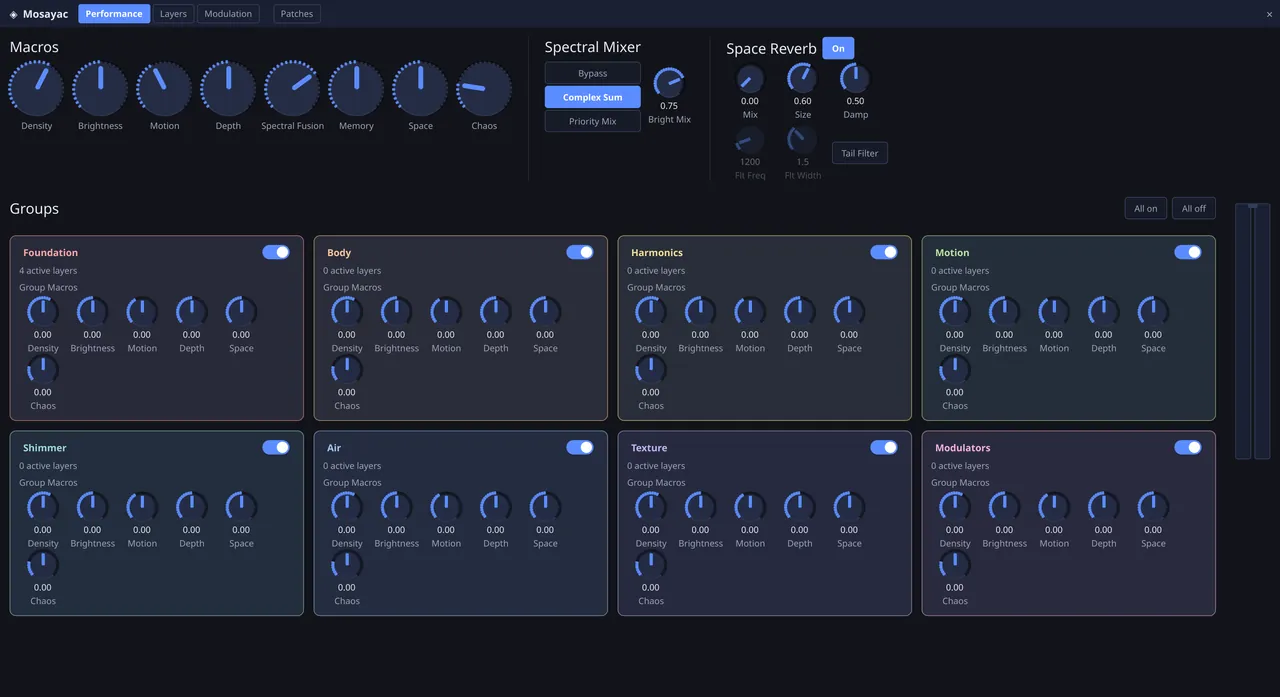
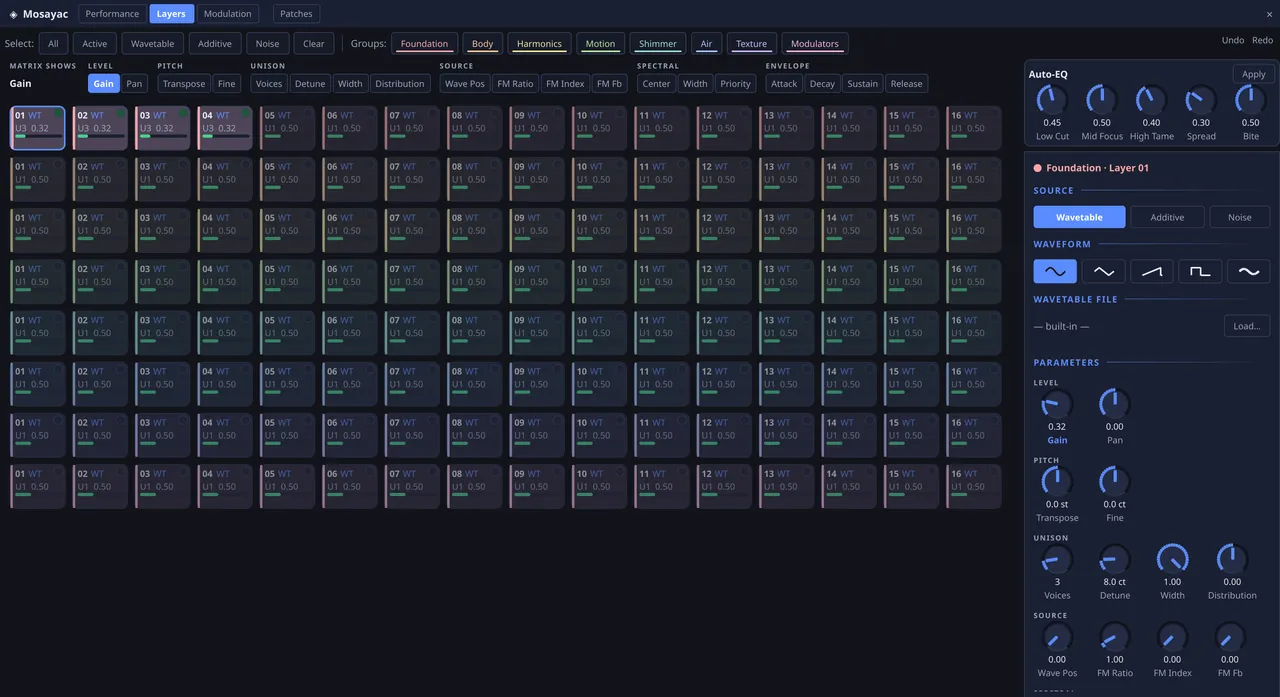
Mosayac organises up to 128 layers in eight musically named groups — Foundation, Body, Harmonics, Motion, Shimmer, Air, Texture and Modulators. Every layer brings its own wavetable, additive, noise or FM source, and spectral mixing gives each one a place instead of stacking them into mud. As a plugin it shares its engine, state and parameter IDs with VibeField Studio.
- layer slots
- 128
- sound groups
- 8
- sources per layer
- 4
Signal path
- MIDI
- 128 layers · 8 groups
- spectral mix
- macros · modulation
- Space reverb
- stereo out
- Wavetable, additive, noise and two-operator FM — per layer.
- Eight performance macros: Density, Brightness, Motion, Depth, Spectral Fusion, Memory, Space and Chaos.
- A modulation matrix with LFOs and random walks, per-layer shaping EQ and a shared space.
- Engine, state and parameter IDs shared with VibeField Studio.
128 parts, one instrument
Mosayac organises up to 128 layers in eight musically usable groups. Each layer can take its own character, space and spectral position; the groups turn the mass back into something you can play.
Specifications and limits
Verified
- 8 groups of 16 layer slots, stably addressed.
- Per layer: gain, pan, transpose, fine tune, ADSR, HP/LP, four-band EQ and up to eight unison voices.
- Batch edit, distribute, deterministic randomise, copy/paste and group mute, solo and transpose.
- Wavetable engine with five built-ins, mip levels, morph and frame scan, and imported multi-frame WAVs.
- Additive engine with 1–64 partials, tilt, odd/even balance, inharmonicity and phase spread.
- Deterministic noise with a colour filter, plus two-operator phase FM with feedback per layer.
- Modulation matrix with LFOs and random walks, performance macros, per-layer shaping EQ and a shared reverb send driven by the Space macro.
Limits
- 128 counts logical layer slots, not 128 guaranteed simultaneous voices.
- Real performance depends on the patch, the polyphony, the backend and your hardware.
- Wavetable import is WAV-based in the current workflow.
- There is no visual wavetable drawing editor.
- Per-voice modulation sources currently use the most recent active voice as a proxy.
- This is not MPE and not an unlimited modulator count.
02 / 03 · Polygon synthesizer · VST3 instrument
Cyclope
Play the shape of a sound.
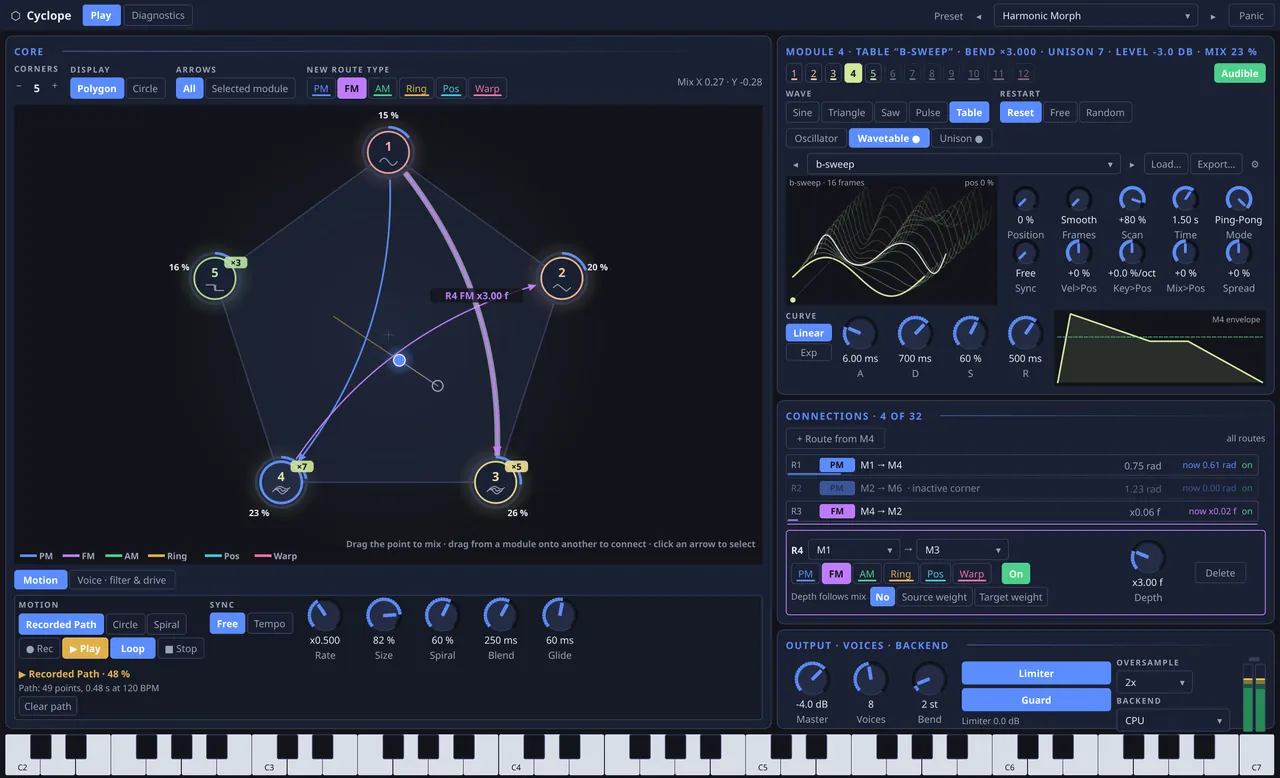
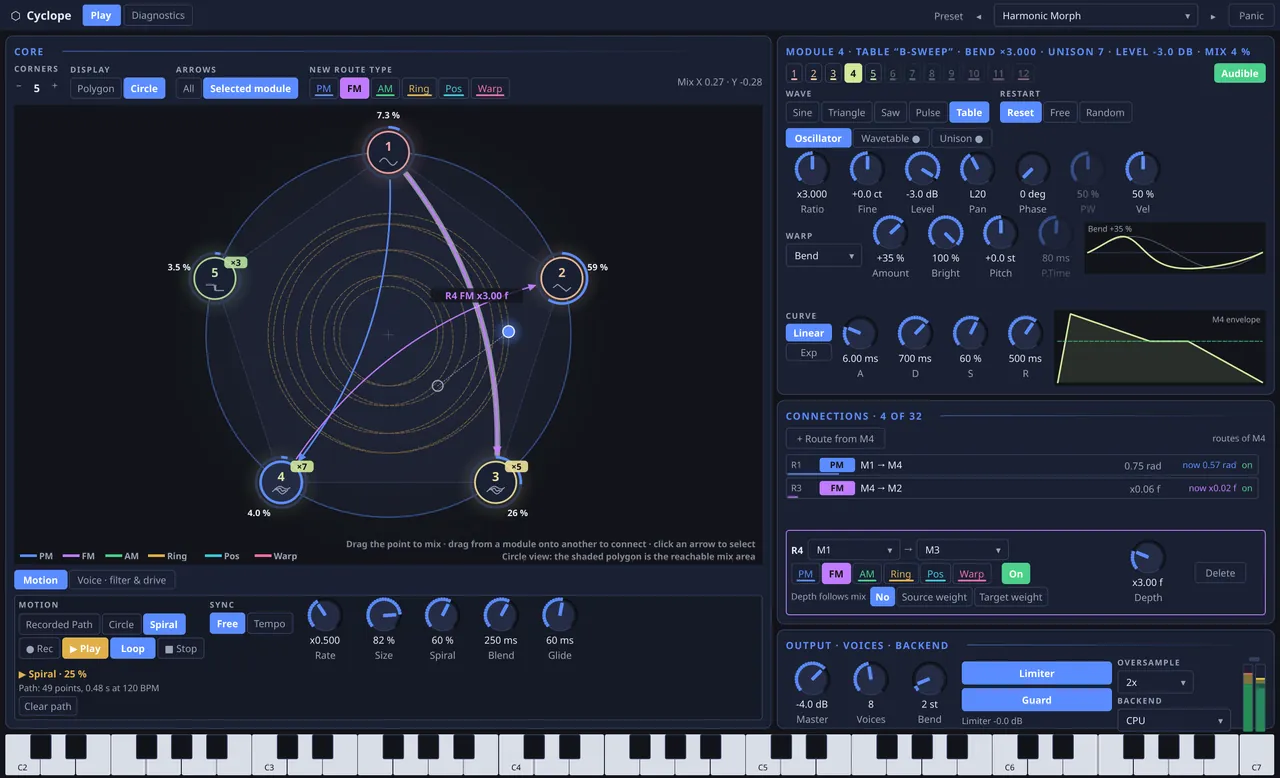
Cyclope places up to twelve oscillator modules on the corners of a polygon. A point inside it mixes them; arrows between the corners let them modulate each other — phase, frequency, amplitude, ring, table position and warp, feedback included. Record the point’s path, loop it, or send it on a circle or a slowly breathing spiral, free or locked to the host tempo.
- corners
- 3–12
- route types
- 6
- unison per module
- 16×
Signal path
- MIDI
- 12 modules × 16 unison
- PM · FM · AM · ring network
- geometric mix
- filter ⇄ drive
- 2× oversampling
- stereo out
- Sine, triangle, saw, pulse or wavetable per corner — eight factory tables, plus WAV and Surge .wt import.
- A module can be a pure modulator: the corners become the carriers and operators of an FM synth you can see.
- Per voice: a resonant filter (LP 12/24, BP, HP) with its own envelope, and drive.
- 12 factory presets, from psy basses to pads and a wavetable scan.
03 / 03 · Algorithmic reverb · VST3 effect
VibeField Reverb
A reverb that shows what it is doing.
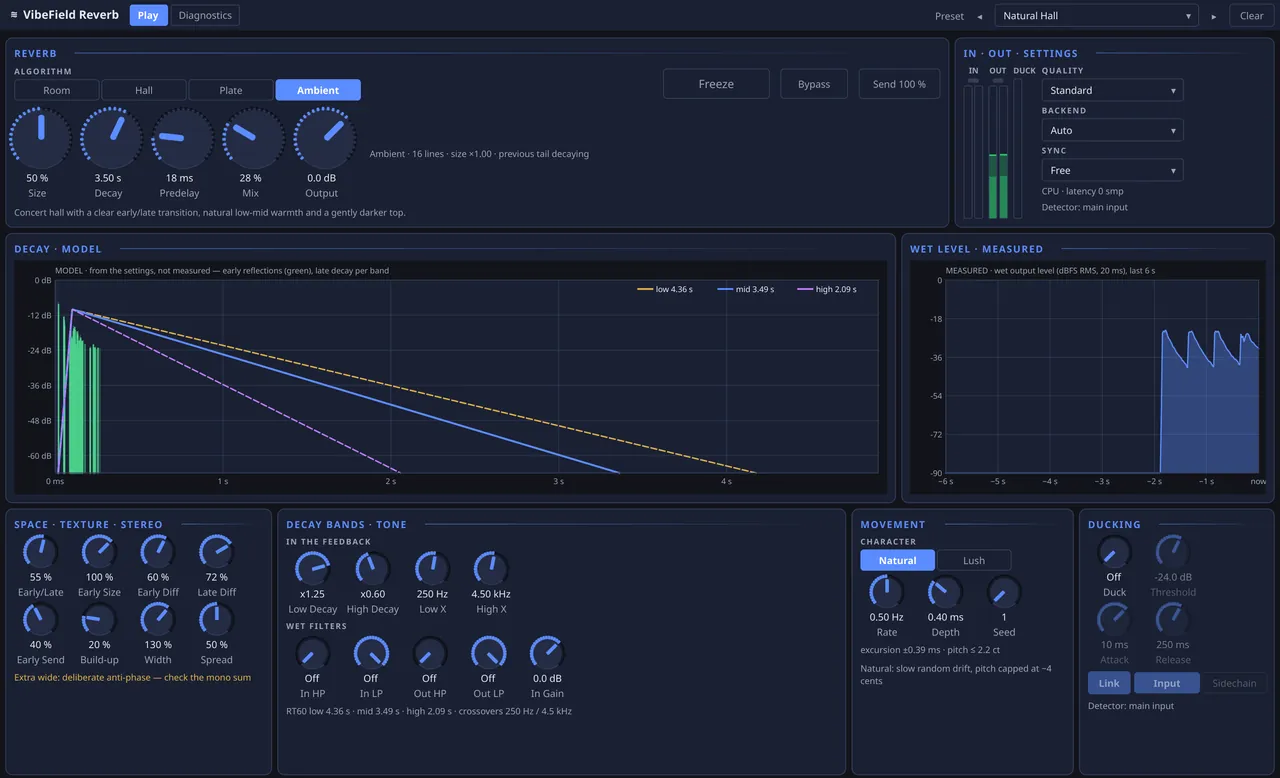
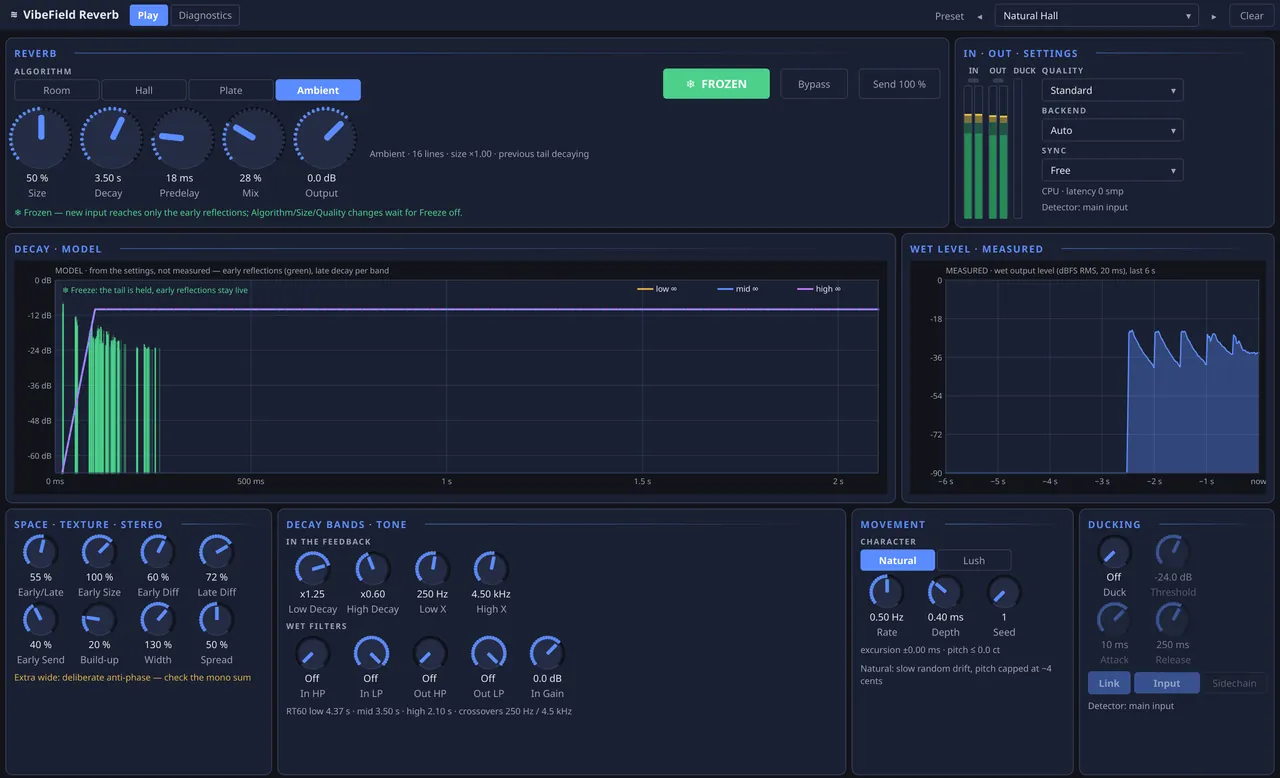
Room, Hall and Ambient run on a feedback delay network of 16 lines — 32 at High quality; Plate runs on a ring of coupled allpass sections. In front sits a true-stereo model of the early reflections, and inside the feedback the decay depends on frequency. The decay view draws what your settings imply and labels itself as a model; the wet level next to it is measured.
- algorithms
- 4
- maximum decay
- 30 s
- samples latency on CPU
- 0
Signal path
- in
- predelay
- early reflections
- diffusion · build-up
- FDN 16/32 or plate ring
- width · wet EQ · ducking
- dry/wet out
- Decay from 150 ms to 30 s; predelay up to 500 ms or as a note length synced to the host.
- Freeze holds the tail, Clear empties it with a 10 ms fade.
- Ducking from the input or a sidechain; width from 0 to 200 %, level-compensated.
- 13 factory presets, from a tight drum room to a frozen texture.
VST3
Formats and platforms
The same matrix for all three: every plugin, on both systems, as a CPU and as a CUDA build.
Limited| Plugin | Type | Windows 10/11 x64 | Debian/Ubuntu x86-64 |
|---|---|---|---|
| Mosayac | Instrument | CPUCUDA | CPUCUDA |
| Cyclope | Instrument | CPUCUDA | CPUCUDA |
| VibeField Reverb | Effect | CPUCUDA | CPUCUDA |
Honest limits
- Format: VST3 only.
- The Windows builds are not code-signed yet, so Windows SmartScreen may show a warning.
- There is no host compatibility matrix yet: results per DAW are not published. We would rather name no host than one we have not measured.
- The CUDA builds need an NVIDIA GPU and driver for the CUDA path; without one they render on the CPU.
- No MPE and no per-note expression.
How you get them
- 01Apply for Founder Beta.
- 02Once you are accepted, your access becomes active in your account.
- 03Download Studio and all three plugins — Windows or Linux, CPU or CUDA.